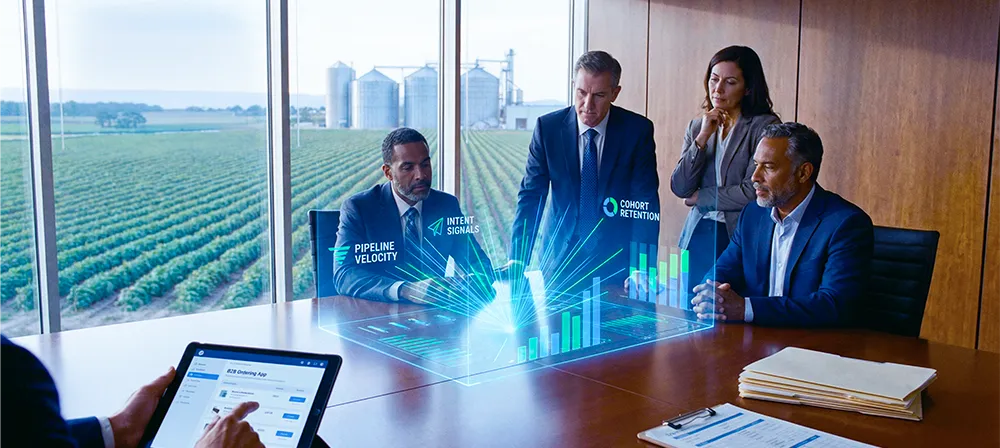
The myth that the agribusiness sector is “different” because it gets its boots dirty is killing your profitability. For decades, executives have hidden behind tradition to justify slow, bureaucratic sales processes based on the “courtesy visit.” But I have some uncomfortable news: Your customer no longer compares your service to your direct competitor; they compare it to the last experience they had on an E-Commerce App.
Today’s agricultural producer lives an absurd dichotomy. In the morning, they buy high-tech parts for their home or manage their finances with a single click. In the afternoon, to buy inputs for their harvest, they have to wait 15 days, go through four phone calls with an advisor who lacks real-time data, and sign physical paperwork.
This friction isn’t “tradition”—it’s operational inefficiency. According to data from McKinsey & Company, more than 70% of B2B buyers now prefer remote digital interactions or self-service over traditional human contact. If your demand generation strategy still depends on a salesperson “being in the area,” you are already too late.
The true enemy of an agribusiness company isn’t the brand across the road; it’s the attention economy. While you are planning an agricultural fair to capture leads, an E-Commerce platform’s algorithm has already profiled your customer, understood their needs, and offered a solution in seconds.
We are facing the “Retailization of Agro.” If your company’s demand generation process isn’t as intuitive as ordering food delivery, you are handing over your market share on a silver platter. Customers don’t leave because of price; they leave for convenience.
Most industry leaders privately confess that their CRMs are data graveyards. They hold information from three crop cycles ago that serves no predictive purpose. In this scenario, survival doesn’t depend on producing more, but on generating demand with precision and strategy.
Thriving organizations are those that have stopped “guessing” and started implementing Account-Based Marketing (ABM) and strategic Inbound models. It’s not about flooding the internet with ads; it’s about being present with the exact data point when the producer is researching their next planting cycle.
Is it aggressive to say your sales model is a fossil? Perhaps. But it is more painful to watch your company’s value erode while the digital agility of other sectors educates your customer to demand what you currently cannot provide.
Modern demand generation is not brochure marketing; it is process engineering. Those who succeed in integrating Big Tech efficiency with deep knowledge of the land will not only survive—they will dictate the rules of the game for the next decade. The question isn’t whether agribusiness will change, but whether you will be the one leading the change or the one reading about it in liquidation reports.
Maintaining a reactive sales model is, ultimately, a decision to cede market share. At Echez Group, we help senior leadership regain control of the pipeline through demand architectures that transform field uncertainty into predictable financial assets. Is your commercial structure designed for the 2026 market, or just to survive the current cycle? Let’s discuss your next competitive advantage.